
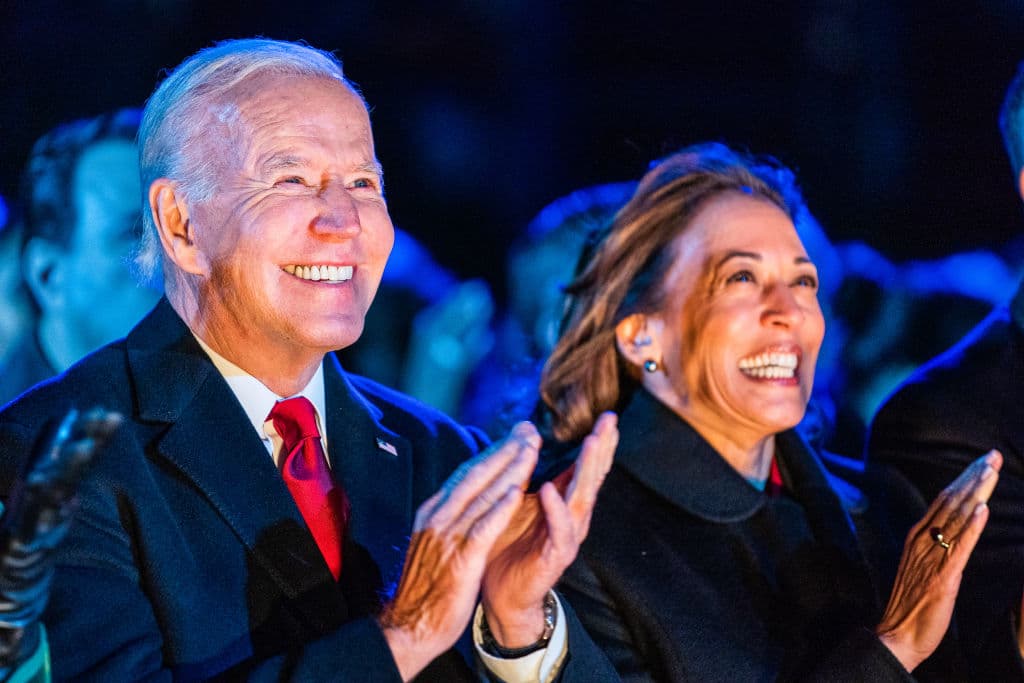

President Joe Biden did not receive a cup of good cheer on Dec. 15, except for perhaps kicking the fiscal can down the road by averting a government shutdown. The US economy considerably weakened in November as a plethora of data measurements were released, which comes soon after the Federal Reserve raised interest rates and warned that the country still had a long way to go until the inflation challenge was resolved. Suffice it to say, Santa Claus might not be visiting the White House this year.
The Joe Biden Boom Fades?

 Fed Chair Jerome Powell did warn that the American people should brace for the end of the boom and welcome an era of slower economic growth. This was reiterated in the central bank’s Survey of Economic Projections (SEP), which forecasted abysmal GDP expansion rates of 0.5% in 2023 and below 2% in 2024 and 2025. Next year, as the Eccles Building continues to pursue a path of restrictive policy – decelerating the increase in the money supply through higher interest rates – it should be riveting to determine how the national economy will stand without the training wheels.
All of this led to one of the worst days in the stock market this year, as the leading benchmark indexes hemorrhaged red ink and added to their substantial 2022 losses.
Fed Chair Jerome Powell did warn that the American people should brace for the end of the boom and welcome an era of slower economic growth. This was reiterated in the central bank’s Survey of Economic Projections (SEP), which forecasted abysmal GDP expansion rates of 0.5% in 2023 and below 2% in 2024 and 2025. Next year, as the Eccles Building continues to pursue a path of restrictive policy – decelerating the increase in the money supply through higher interest rates – it should be riveting to determine how the national economy will stand without the training wheels.
All of this led to one of the worst days in the stock market this year, as the leading benchmark indexes hemorrhaged red ink and added to their substantial 2022 losses.
‘A Great Trajectory’
Speaking in an interview with MSNBC on Dec. 14, Sen. Debbie Stabenow (D-MI) argued that the 7.1% consumer price index (CPI) in November suggested that the nation is on a great trajectory. Perhaps she will champion canceling the Inflation Reduction Act now! But, in all seriousness, politicians may need to realize why price inflation is coming down – and it has nothing to do with President Joe Biden.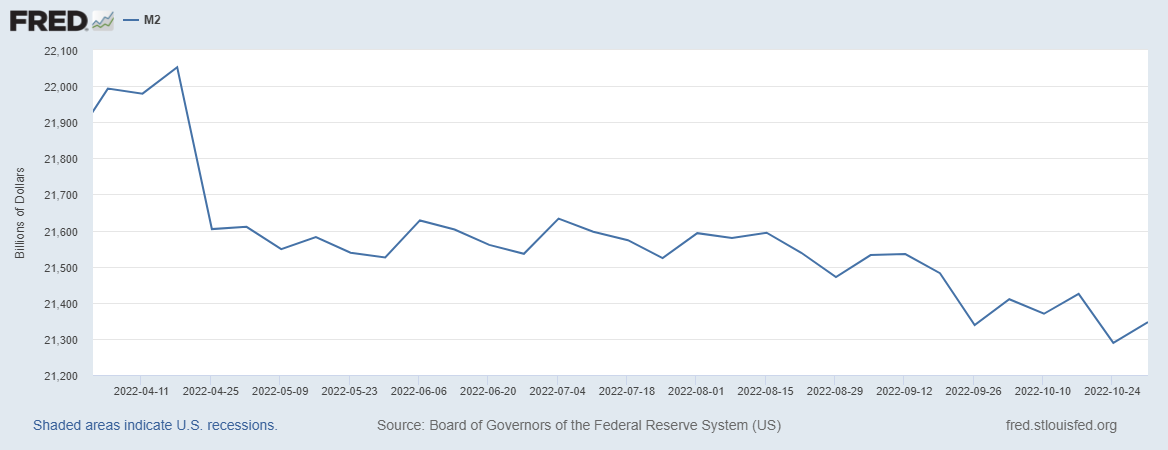
The biggest thing is that less money is being pumped into the economy. The total M2 money supply is at a one-year low, while the expansion rate has slowed to a pre-pandemic pace. Although the damage has been done by eroding Americans’ purchasing power, the pain has not diminished. It is comparable to what Bela Lugosi tells Boris Karloff in 1934's Black Cat: "That's what I'm going to do to you now - fare the skin from your body... slowly... bit by bit!"
The next critical development in this inflation-busting crusade has been falling demand. Sure, consumer spending is robust – fueled by credit cards and less saving – but the various purchasing managers’ indexes (PMIs), which highlight the direction of economic sectors, show plummeting demand, be it export orders or new order growth. When this transpires, the market responds by slashing prices to resuscitate consumption. Of course, there is always the risk of recession since two-thirds of the US economy is driven by the consumer. Indeed, this is the endgame for the Federal Reserve: cooling down the economy to restore price stability.



.jpg&w=1920&q=75)