
Lost amid the broader cultural and political impact of the rapid demographic changes in America this century are the simple daily life experiences of average American citizens. Imagine feeling like a foreigner in the town you grew up in. It’s a problem confronting longtime residents of Dearborn, MI, square in the face.
The exploding Muslim influence on this formerly working-class Rust Belt town has served as fodder for national news stories for several years now, but there has been a noticeable lack of attention granted to the on-the-ground perceptions of the everyday people whose lives have been profoundly affected by such swift change.
“Dearborn became the first Arab-majority city in the US in 2023, with about 54.5% of its population identifying as Middle Eastern or North African according to 2020 US Census data,” state news outlet Michigan News Sourcereported April 8. “It is also home to the Islamic Center of America, the largest mosque in North America. Nearby, Hamtramck made history in 2021 by electing an all-Muslim city council and its first Muslim mayor.”
It’s part of a larger trend throughout the Wolverine State. “Of the nearly 700 cities and townships in Michigan with at least 2,500 people – where over 90 percent of the state population lives – the percentage of minorities rose in all but 11 of them,” according to 2020 US Census figures, Bridge Michigan news service reported in 2021.
‘New Populations Reshape Daily Life’
In Dearborn, the transformation has been overwhelming. That 54.5% Middle Eastern population figure is widely considered to be grossly understated. “I think it’s probably closer to 70%, just based on the fact if you look at the population of Dearborn Public Schools,” Center for Arab Narratives Director Matthew Jaber Stiffler told WDIV-TV in Detroit in 2023.
The effects can be seen all over town. Six candidates are in the running to become new superintendent of public schools in Dearborn. Four are of Arab ethnicity. The police force is 45% Arab-American. The result has been marked changes in policies directed at the general public. It’s enough to make people feel like a stranger on their own soil.
“In an email obtained by Michigan News Source, a 66-year resident of Dearborn Heights has described what he sees as a dramatic transformation and warned about … changes in businesses, schools, and neighborhoods. He claims longtime residents are leaving, while new populations reshape daily life,” the news site detailed in its April 8 article. While anecdotal, it’s a viewpoint largely ignored by the big-box media.
Above all, the missive serves as a snapshot of profound alienation from an American citizen speaking of the town he has long called home:
“In his message, the resident alleges that his community has undergone a dramatic and troubling shift, claiming that Arab residents now dominate local businesses, schools, government, and public life while longtime residents are being pushed out.“He accuses local officials and police of unequal enforcement, describes worsening traffic, overcrowded housing, and strained infrastructure, and claims quality of life has declined due to noise, litter, and safety concerns. The man also alleges tensions between residents, saying he feels unwelcome in his own neighborhood after decades of living there. He is planning to leave, portraying the situation as a complete breakdown of the community he once knew.”
He is not alone. On March 24, local resident Andrea Unger spoke at a Dearborn City Council meeting. She reiterated ongoing resident noise complaints about the Islamic call to prayer that regularly rings throughout the city. But she was also alarmed by what she discovered at her local police department.
“When I went to the city police station to file a report, I found a stack of these papers that I distributed to you completely written in Arabic,” Unger told the city council members. “There appears to be selective help given to some groups and not to others. Why are city government notifications only given in a foreign language and not in English? Why are we daily forced to listen to other faiths’ worship while we’re in our own homes?
“We now have new faces in our legal department, and as my own lawyer is looking at the discrimination of Christians and the violations of our rights by the City Council and the Dearborn police, I hope our city can put a stop to this harassment.”
Shia Pilgrimage City of Dearborn
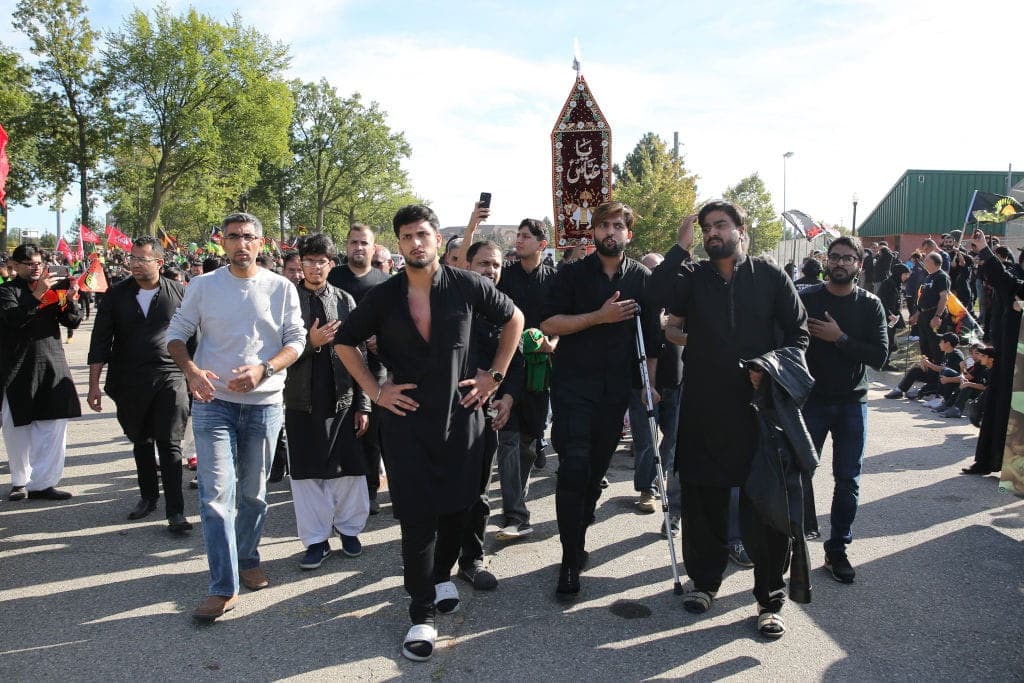
Last August, an estimated 40,000 people marched through Dearborn to mark the annual Muslim Arbaeen procession. Arbaeen honors “a grandson of Prophet Muhammad slain in a battle in Karbala, Iraq, in the 7th century against an unjust ruler,” The Detroit Free Press reported. The Dearborn procession is “the largest outdoor religious gathering of Shia Muslims in the US,” the paper noted.
The 2025 march featured a bold new public observation.
“For the first time in the history of the Dearborn procession, afternoon prayers were held outside on Warren Avenue before the start of the Arbaeen march instead of inside the Karbalaa center,” The Free Press wrote. “Dearborn police blocked off the street as volunteers rolled out blue mats for hundreds of congregants to sit on.”
Devout Shia Muslims unable to travel from other parts of the US to the holy city of Karbala, Iraq, to celebrate the holiday instead head to Dearborn. “Here is the only place in America that makes you feel like (being in Karbala),” Hasan Ballenger of Columbus, OH, told the paper.
It’s an uncomfortable question that the proponents of “diversity” will not be able to suppress much longer as the stark realities of massive demographic change make themselves known. At what point does “inclusivity” morph into social and cultural conquest?

.jpg&w=1920&q=75)