

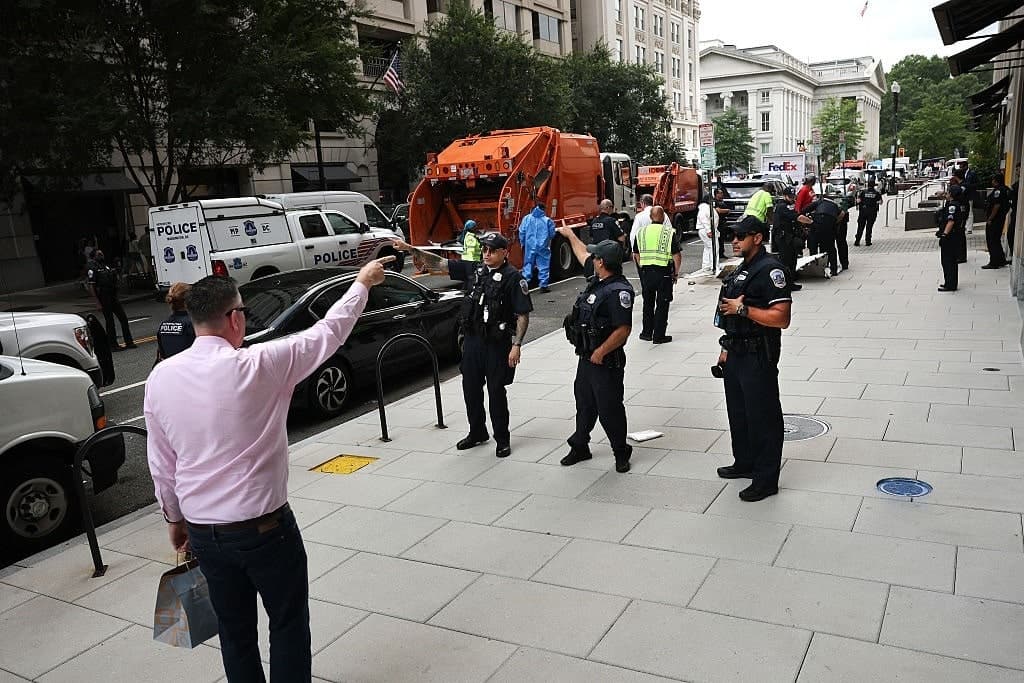

Yet again, President Donald Trump has irked the nation’s media with a calculating plan to help homeless people. With terms like “detention camps” being liberally (in all senses of the word) applied, it has become increasingly clear that the left-leaning Fourth Estate will oppose any policy from this administration regardless of its efficacy or intent.
As part of the recently announced mission to clean up the streets of Washington, DC, White House Press Secretary Karoline Leavitt said: "Homeless individuals will be given the option to leave their encampment, to be taken to a homeless shelter, to be offered addiction or mental-health services, and if they refuse, they will be susceptible to fines or to jail time." Horrified gasps in written form ensued from the Democrat-aligned press. But was the reaction in any way genuine? It doesn’t take long to find double standards on this precise issue.
A Tale of Two Cities
The Olympic Games will be heading to Los Angeles in 2028, and Mayor Karen Bass has schemes in place to remove homeless folks from key areas in advance of the competitions. Interviewing with the LA Times last year, she said – without offering specific details – that “the goal will be to significantly reduce street homelessness and significantly increase the move from interim [housing] to permanent.”

As the Times reports, “At the center of Bass’ approach is Inside Safe, an encampment-clearing program in which dwellers receive beds in hotels, motels and other types of temporary housing.” The outlet notes that approximately 28% of those housed moved back to the streets and that many of the encampments have “simply repopulated.”
Perhaps the widescale failure of such efforts was due to not providing the “addiction or mental-health” services offered under Trump’s proposal. It is an oft-ignored reality that not all homeless people want to be housed. In some cases, this is a lifestyle preference, but in many, it is more likely that, as sheltered accommodation does not permit the use of drugs or alcohol, addicts choose their vices over security.
And let’s not forget California Governor Gavin Newsom’s removal of homeless people when Chinese dignitaries came to visit. As the San Francisco Standard noted at the time, “City workers cleared two encampments on Van Ness the week before the conference. But it was not their first trip to the street: City workers visited the street 23 times to clear encampments over a six-month span starting in April, according to the Department of Emergency Management.”
An Outcry for the Homeless
“Homeless people in detention camps?” reads a recent headline in the LA Times. It’s a sentiment echoed across the media. Indeed, one might assume that getting homeless people off the streets was a bad thing, judging by the outcry.
When the Supreme Court ruled in 2024 that outdoor sleeping could be criminalized in the case of City of Grants Pass v. Johnson, similar pearl-clutching ensued. But what is Trump actually trying to achieve?
As part of his efforts to clean up Washington, DC, getting the homeless population into accommodation and providing access to drug and mental health treatment would go a long way. In 2022, the San Diego DA Office published figures showing that those classified as homeless were:
175 times more likely than non-homeless people to commit robbery
130 times more likely to commit assault
183 times more likely to commit residential burglary
514 times more likely to commit arson
Police Department data from Los Angeles determined that homeless people, while being only 1% of the population, are prime suspects in 6% to 8% of all crimes. In the case of violent crimes, this rises to 11% to 15%.
But it is not just for the safety and security of those with homes that clearing the streets would be advantageous.
The San Diego data reveals that homeless people are also victimized at far higher rates. They are, for example:
19 times more likely to be murdered
27 times more likely to be the victim of attempted murder
9 times more likely to be the victim of sexual assault
And there is clearly an overlap between victims and victimizers. Living in homeless encampments means that individuals are exposed to those with severe mental illness and drug addiction on a daily basis. If any person were 27 times more likely to have someone try to kill them, wouldn’t it be wise to provide them with an opportunity for safety? Apparently not, according to the nation’s press.
TDS Reigns Supreme
Since Donald Trump announced his candidacy a decade ago, the Fourth Estate and his political opponents have sought to take the opposite view on just about every issue he raises or tackles. In the months since his second inauguration, this brick wall of defiance has only been strengthened. Subdue Iran’s nuclear threat? Shock; horror. Oversee peace accords in half a dozen deadly conflicts around the world? "He failed on Ukraine!" Virtually halt illegal immigration at the southern border? Let’s redefine America. And tried to solve the brutal “lived experience” of DC’s homeless population? Well, clearly, as far as the once-vaunted nation’s press is concerned, that’s basically the same as rounding up people and putting them in detention camps.

.jpg&w=1920&q=75)
.jpg&w=1920&q=75)
.jpg&w=1920&q=75)