


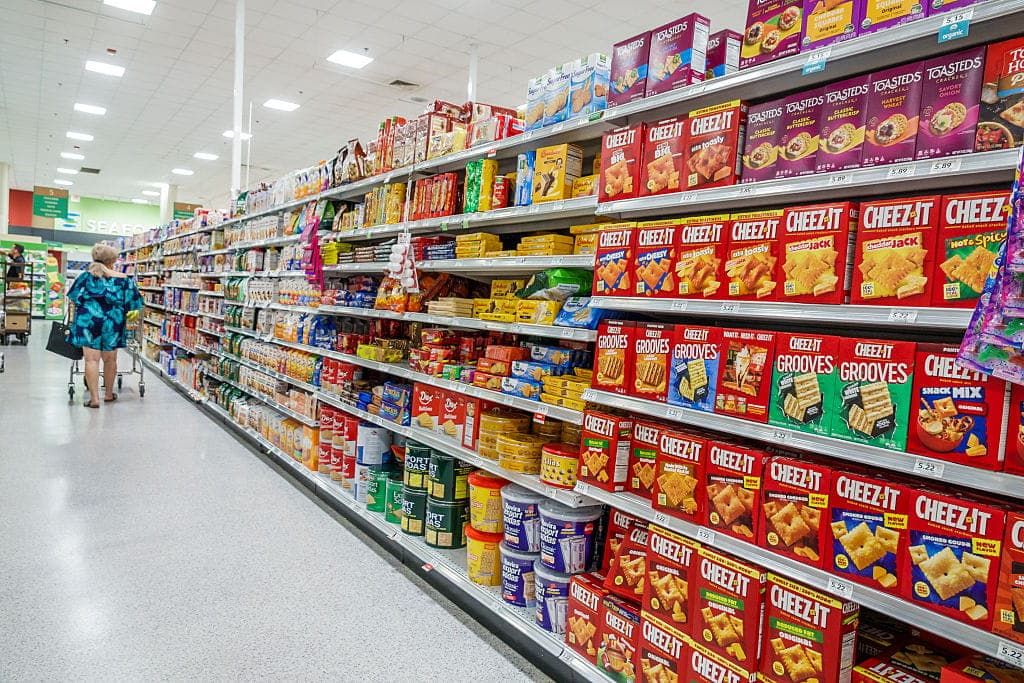

Out with the ultra-processed and in with the whole foods. Disciples of the Make America Healthy Again movement, commonly called MAHA, are grinning from ear to ear as they see their fellow citizens consume more protein and vegetables and fewer packaged goods. But while shoppers are avoiding grocery aisles stocked with Oreo cookies and Coca-Cola, food companies and investors are seeing their share prices plummet.
MAHA Doing the Trump Dance
A June 2026 survey by Cornell University found that more than 60% of respondents agreed that prepackaged baked goods, processed meats, and sugary drinks are addictive, cause obesity, and are bad for your health.
Despite the mainstream media painting a picture of healthy eating and exercise as polarizing initiatives, researchers say this message is spreading across ideological lines.

Free with the Daily Briefing
85EssaysUnravel the Constitution
Hamilton, Madison & Jay’s complete case for America, free and searchable in the Publius Reader.
Free with the Daily Briefing. Unsubscribe anytime.
“Public health issues have become increasingly polarized in the United States,” said Jeff Niederdeppe, senior associate dean of faculty and research at the Cornell Jeb E. Brooks School of Public Policy. "Our results show that ultraprocessed foods are breaking through ideological barriers. This suggests there may be a durable foundation for policy change.”
A key metric for assessing the efficacy of MAHA is how consumers vote with their wallets. Since August 2024, industry data show that real food sales have been outpacing ultra-processed transactions by 7%. But the best evidence is in the stock prices of various processed food makers, particularly at a time when Wall Street is flirting with record highs.
Here is a breakdown of how these stocks are performing year-to-date:
- Conagra (Duncan Hines, Slim Jim, and Snack Pack): negative 19%
- General Mills (Lucky Charms, Nature Valley, and Pillsbury): negative 20%
- Hershey (Kit Kat, Reese's, and Twizzlers): negative 7%
- PepsiCo (Cheetos, Doritos, Pepsi, and Tostitos): negative 4%
Other stocks have also trended downward after the birth of MAHA a couple of years ago. Since July 2025, Kraft Heinz (mac and cheese and Oscar Mayer Wieners) is down 7%, while Mondelez (Chips Ahoy!, Oreo, Nabisco, and Ritz) is down about 12%.
John Klar, a national correspondent for Liberty Nation News and a farmer, says markets will be critical for advancing MAHA principles.
"These market numbers for food company stocks display the enduring and irrevocable impact of the MAHA movement. As Americans vote for food policy with their wallets, they will change the food system. Shoppers are reading labels. Young people are eating healthy meats and produce.
"The way to end glyphosate, unhealthy food additives, and chronic disease is through a free market with a MAHA-informed public. Much like the tobacco industry declined in power as people learned of lung cancer, glyphosate use will decrease as consumers turn away in disgust. Food companies will shift their offerings to satisfy informed consumer demand or go bankrupt as their market share rightly plummets."
The Ozempic Way
While Americans might be more aware of the junk ingredients inside packaged foods, another factor could be GLP-1.
Ozempic and Wegovy users typically experience reduced appetite and altered taste buds. As a result, companies are doing either one of two things. The first is intensifying their flavors through more salt, fat, and sugar. The second is to adapt to evolving consumer preferences, such as higher protein, greater fiber volume, and more vitamins.
From Liberty Nation News, Trivia, Facts, Check Us Out
Stay informed.
Today’s news, the Constitution and American history, written for young readers.
Visit GenerationLiberty.com
News, Trivia, Facts, Check Us Out
Stay informed.
Today’s news, the Constitution and American history, written for young readers.
Visit GenerationLiberty.com
GlobalData, citing research from the US non-profit RAND, determined that the top beverage manufacturers view GLP-1 "primarily as a threat, rather than a potential opportunity for growth and innovation."
Companies have acknowledged the impact these weight-loss medications are having. PepsiCo says, however, that consumers are still using its brands in their buying patterns. "They’re eating less quantities, so our offerings in the small portions — whether it’s multipack or some other options [—] will make sure that our brands stay relevant to those consumers," the company said in an earnings call last year.
MAHA or Ozempic … or Exercise?
More Americans view exercise as essential. Heading into 2026, a Health & Fitness Association survey found that Americans planned to spend approximately $60 billion on health and fitness. This mirrors a YouGov poll that found a quarter of Americans viewed exercising as their top goal for the new year.
It seems the US government has noticed the trend. The Centers for Disease Control and Prevention launched a national initiative – Active People, Healthy Nation – that aims to help 27 million Americans become more physically active by next year.
America’s population could be drastically different in the next generation. If the current trend of eating healthy, exercising more, and shedding pounds becomes the new normal, the United States could become the land of the free – and the home of the fit.


.jpg%20noncitizen%20voting&w=1920&q=75)
.jpg%20Hillary%20Clinton&w=1920&q=75)