


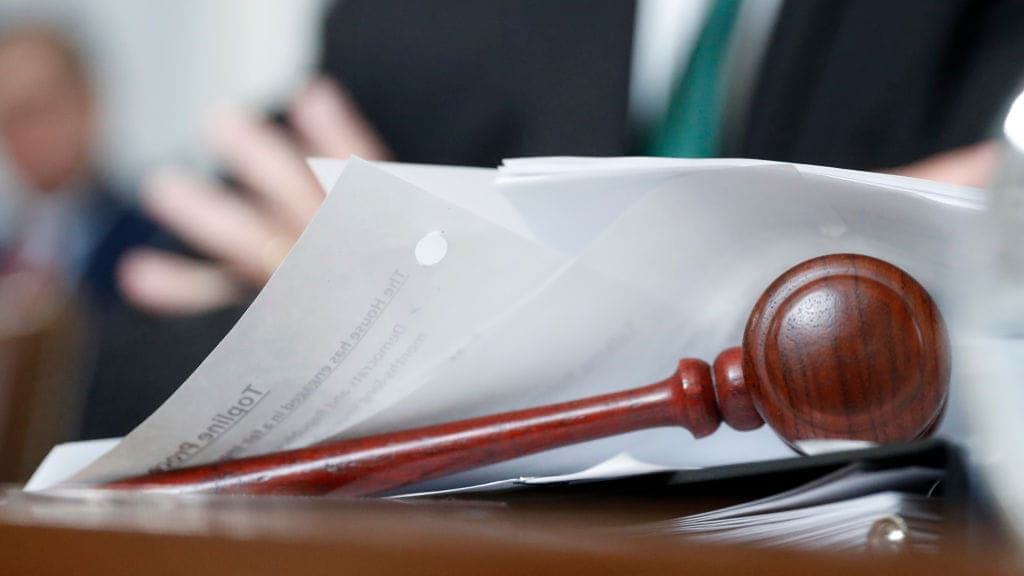

Kentucky’s legislature and state supreme court are facing off in an epic battle over the parameters of their respective authority. This separation-of-powers turf war centers on a legislative effort to impeach a sitting judge. The Kentucky Supreme Court has ruled that only the judiciary has this power in the absence of serious impropriety. In response, the legislature voted overwhelmingly on its last day of session to censure a supreme court judge for his opinion in the case. The gloves are off.
Hatfields and McCoys?
Observers claim this eyebrow-raising warfare has long simmered between Kentucky’s Republican-dominated legislature and the state’s highest court. The current iteration stems from the legislature’s use of its constitutional power to impeach public servants to initiate proceedings to remove a judge, not for criminal acts but for bad decisions. At a time when activist judges create public outrage by going too soft on violent criminals (or, as in a recent case in Minnesota, aiding an illegal immigrant to escape out the side door of the courthouse), similar efforts may arise in other states.
Fayette Circuit Judge Julie Muth Goodman rendered six decisions the legislature cited as grounds for removal, including dismissing a murder indictment, reversing a jury verdict of conviction, imposing probation instead of a five-year sentence, and releasing a convict from prison 21 years early. All of these decisions were reversed on appeal, but the Kentucky legislature listed them as grounds for impeachment.
Judge Goodman is not accused of accepting a bribe, engaging in illicit sexual conduct, or driving drunk. In a 5-1 decision, the Kentucky Supreme Court ruled that the legislature lacked the constitutional authority to impeach her. In his concurring opinion, Justice Kelly Thompson wrote:
“Officials cannot be impeached for a traffic ticket. They cannot be impeached based on a political disagreement or an unpopular decision. They cannot be impeached because they have blue eyes. They can only be impeached for criminal conduct that occurs during their term of office.
“As a matter of constitutional interpretation, Judge Goodman’s conduct as alleged cannot qualify as a ‘misdemeanor in office.’ The allegations against her, even if fully believed, do not establish that she has engaged in a criminal act in office. The legislature would strip us of our power to interpret the Kentucky Constitution and require us to blindly defer to its political judgment.”
Indignation Escalation
But Judge Goodman didn’t stop there, asserting that lawyers (in the legislature) who refused to acknowledge the authority of the state’s highest court to adjudicate the interpretation of the Kentucky constitution could be referred for disbarment and possible criminal accountability. This certainly upped the ante between the warring branches, prompting the passage of a censure motion by a whopping vote of 77-15 in the Kentucky House. House Resolution 140 defiantly states, in part: “This honorable body affirms that the impeachment powers of the General Assembly remain inviolate and declares that those powers cannot be limited, circumscribed, or otherwise violated by the Kentucky Supreme Court or anyone else….”
The Senate Impeachment Committee suspended (but did not terminate) impeachment proceedings against Judge Goodman pending review by the Judicial Conduct Commission. This was only a partial tip of the hat to the Kentucky Supremes, as if to say, “If you don’t take care of Goodman, we will!” Such high-stakes hijinks would be alarming in any state.
Just hours before the House resolution, the Kentucky Senate passed a censure resolution against Judge Thompson sponsored by Senate President Robert Stivers. In prompt retort, Judge Thompson shot back:
“I have great respect for President Stivers and am honored I got under his skin.
“The beauty of our democracy is the will of the people in an election is sacrosanct. To remove an elected official is very serious business. That’s what I said. It takes a grave offense to impeach. I wrote an opinion that says he can’t impeach for an opinion and he retaliates against me for my opinion.”
Kentucky Internecine Warfare
These barbs reflect a deep-seated rivalry that both sides claim threatens the balance of powers of the Kentucky government. Caleb O. Brown of the Bluegrass Institute told Liberty Nation News: “The Kentucky Supreme Court has declared war on the separation of powers in Kentucky.” The legislature has risen forcefully to the challenge, staunchly defending its impeachment turf, backed by the dissenting decision of Judge Christopher Shea Nickell, who stated that “in establishing the judicial power, Section 109 [of the Kentucky Constitution] maintains that ‘[t]he impeachment powers of the General Assembly shall remain inviolate.’ ”
Each side demands that it possesses the power to interpret the law. Judge Thompson expressed in his concurrence that he sees a growing pattern, perhaps reflecting the broader landscape behind the bitter recriminations surrounding Judge Goodman’s impeachment:
“We cannot allow the legislature to arbitrarily threaten impeachment based on its dislike of any of our rulings…. The question we must ask is: Why is the legislature suddenly using its impeachment power to target judges, not for criminal conduct but for their rulings?
“Throughout the history of Kentucky, less than a dozen officers have been impeached. This sparse number of impeachments has suddenly changed. Five impeachment petitions were filed in 2026. Pursuing impeachment proceedings against judges based on disagreeing with their legal decisions is a perversion of the impeachment power and a power-grab that threatens the judicial branch and its independence through intimidation.”
Kentuckians will have to wait and see, popcorn in hand, how this power squabble pans out. The legal dispute is unique to Kentucky law, but the scramble for legislative and judicial autonomy (and the power to impeach) may arise in other states (or the federal government) as well. If so, Americans will do well to recall the (currently ironic) Kentucky state motto: “United We Stand, Divided We Fall.”

.jpg&w=1920&q=75)
.jpg&w=1920&q=75)
.jpg&w=1920&q=75)