


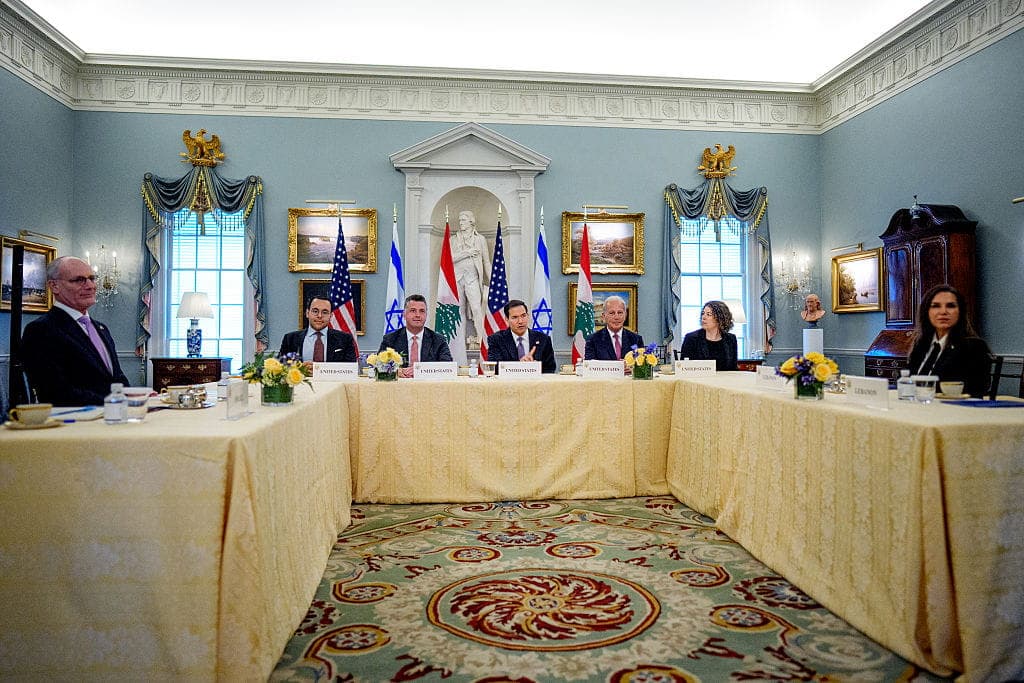

President Donald Trump announced Thursday, April 23, a three-week extension of the ceasefire between Israel and Lebanon. After a second round of talks at the White House involving the president, Vice President JD Vance, Secretary of State Marco Rubio, US Ambassador to Israel Mike Huckabee, US Ambassador to Lebanon Michel Issa, and the Israeli and Lebanese diplomatic teams, the two countries agreed to maintain their fragile peace. Meanwhile, the situation between Iran and the US is heating up. As usual, the region remains a tinderbox, just waiting for the right spark.
Peace in the Middle East – Well, Lebanon, at Least
“The Ceasefire between Israel and Lebanon will be extended by THREE WEEKS,” President Trump posted on Truth Social Thursday. “I look forward in the near future to hosting the Prime Minister of Israel, Bibi Netanyahu, and the President of Lebanon, Joseph Aoun.”
According to the terms of the original ten-day ceasefire, brokered earlier this month, Lebanon must help curb Hezbollah attacks and honor the right of Israel to defend itself against any attacks that do occur. As well, the Lebanese Armed Forces are to assume sole responsibility for the security of Southern Lebanon. In return, Israel agreed to cease offensive operations – air, land, and sea – against Lebanese targets. While the Lebanese Armed Forces are in charge of security, Israeli soldiers will remain in the area during the ceasefire, and the US will lead a five-country “monitoring panel” to resolve boundary disputes and reach permanent peace – which, according to President Trump, must include an agreement that Iran must stop funding Hezbollah.
Before Thursday’s extension, the ceasefire was set to expire on Sunday.
Getting Hotter in Iran – But Not Nuclear
The peace talks and subsequent news follow President Trump’s Tuesday announcement of a similar extension to the ceasefire between the US and Iran – also just before its expiration date. Iran, on the other hand, doesn’t recognize the ceasefire as it is and calls the extension meaningless.
From the Iranian point of view, the continued naval blockade violates the deal, and Iran’s negotiators say they won’t return to the table until the blockade is lifted. Meanwhile, one thing both conflicts have in common is that hostilities never really stopped in either. As of April 22 – well into the ten-day truce between Israel and Lebanon – Hezbollah reported launching drones and rockets at northern Israel. The targets included military outposts and the region of Galilee in general. Israel, in response, has targeted Hezbollah missile launchers in Lebanon. While the conflict has remained below the level of full-scale war between the two countries, the back-and-forth attacks have done damage in military and civilian areas alike and keep the peace, such that it is, fragile at best.
According to Iran, its ceasefire with the US is a farce – and the Iranian military has been acting accordingly. On Wednesday, April 22, Iran took control of two commercial ships in the Strait of Hormuz. The next day, the US seized a tanker transporting oil from Iran in the Indian Ocean, continuing the escalating tit-for-tat. President Trump also said on social media that the Navy was ordered to “shoot and kill any boat” laying mines in the Strait of Hormuz, adding that the Navy would triple the level of minesweeping in the region.
Despite what seems to be an escalation in the Iranian conflict, President Trump assured the press on Thursday that things wouldn’t go nuclear. When asked by a reporter whether nuking Iran was on the table, which Trump called a “stupid question,” he replied: “Why would I use a nuclear weapon when we’ve totally in a very conventional way decimated them without it? No, I wouldn’t use it. A nuclear weapon should never be allowed to be used by anybody.”
Still, the president said time is on America’s side, not Iran’s. “I have all the time in the World, but Iran doesn’t – The clock is ticking!” he wrote on social media Thursday. And Israel is ready to get back in the fight, as well. Israeli Defense Minister Israel Katz said Thursday night (early Friday morning, local time) his country is just waiting on the “green light” from the US to resume attacks on Iran and return it to “the Stone Age.” He added that, once attacks resume, it would destroy “key energy and electricity facilities” and obliterate Iran’s economic infrastructure.
Four countries, two wars – but they’re all interconnected. The tenuous ceasefire between Israel and Lebanon continues, for now, as does the more-or-less one-sided truce with Iran – but lasting peace in the Middle East apparently hinges, as it often does, on the leadership in Tehran. Unfortunately, they seem dead set on preventing it.

.jpg&w=1920&q=75)
.jpg%20Fake%20polls&w=1920&q=75)