

.jpg&w=1920&q=75)

A two-story home surrounded by a white picket fence and a dog named Lassie has been the American Dream for decades. Unfortunately, the quintessential ideal for millions of people has been gradually slipping away since the Global Financial Crisis about 20 years ago. The affordability crisis since 2021 has accelerated the demise of homeownership, and new research suggests the situation is a lot worse than government data show.
Homeownership in America
The Census Bureau has long estimated the US homeownership rate at roughly 65%. That figure comes from a methodology that counts residential properties rather than people, asking whether the owner lives in the home. Under this approach, every owner‑occupied property is treated the same regardless of how many adults share the space, whether it is a single homeowner or a household that also includes adult children, parents, extended family, or roommates.
Economists at the Federal Reserve Bank of Minneapolis contend this commonly cited figure is inaccurate, offering a much lower estimate of the national homeownership rate.
Researchers measured the share of adults aged 18 and over who own their home rather than relying on home occupancy. The regional central bank refers to this metric as the homeowners‑to‑population ratio (HPOP). Under this approach, only the head of an owner‑occupied household is classified as a homeowner; other adults living in the same home are not.
The results? Not good. A little more than half (53%) of US adults own their homes, a 12-point difference. The deeper you go, the worse it gets. Twenty-two percent of adults under age 35, for example, are homeowners, compared to the federal government's 37%.
Additionally, using HPOP at the state level, researchers determined that places with the highest costs had the lowest adjusted homeownership rate. California (41.2%), Hawaii (42.7%), and New York (43.3%) were the bottom three. Wyoming (65.7%), Maine (65.1%), and Vermont (64.3%) had the highest.
"Our approach also quantifies that 13.9 percent of adults in the United States live in owner-occupied homes but are not owners themselves. In other words, more than one in eight of the nation’s adults are misrepresented in the most-cited statistic on homeownership," the economists said in the paper published on July 15.
Using either statistic still reveals the same trend: Today’s young Americans are falling behind compared to previous generations. In 2006, 53% of 34-year-olds owned a home (using HPOP), but today just 45% of people this age are homeowners.
Broken Market
It has been nearly two decades since the Global Financial Crisis, and the housing market still has not fully recovered, at least on the supply side. Total housing starts for new privately owned homes remain well below their 2006 peak, according to the Census Bureau, and even trail pre‑pandemic levels.
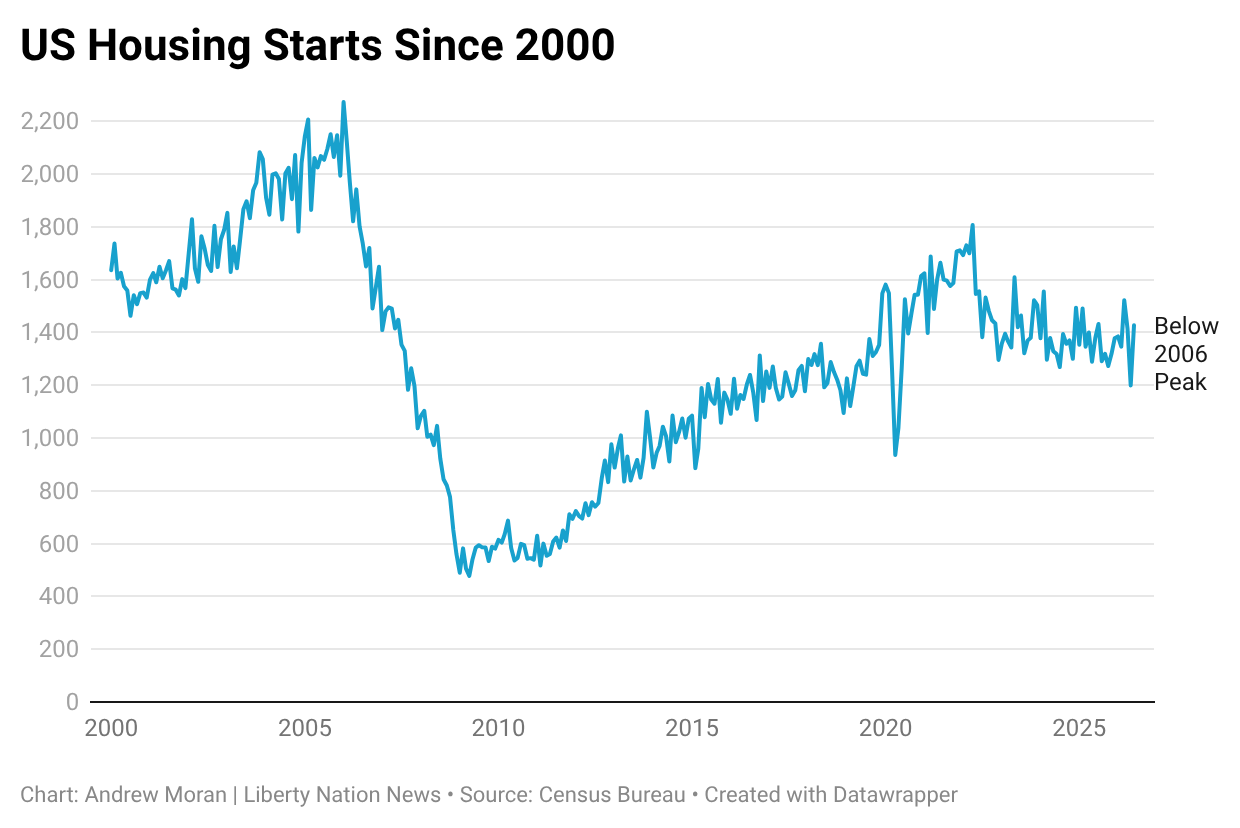
This is why the Federal Reserve’s crisis-era interest rates proved to be a long-term disaster for anyone who did not purchase a home in 2020 or 2021. The US real estate market had already faced a substantial housing shortage, and with a spike in demand, Americans scooped up whatever supply was available. With millions of households locking in 30-year mortgages at 3% to 5%, the golden handcuff effect is now permanent for many families.
Lawmakers have attempted to reverse this trend with the 21st Century ROAD to Housing Act by incentivizing housing construction and restricting Wall Street from purchasing single-family homes (this represents a minuscule amount of the market). But with national median home prices still at record highs and mortgage rates topping 6.5%, it will continue to be a difficult market to navigate in the coming years for families trying to achieve the classic American Dream of homeownership.
.jpg&w=1920&q=75)