

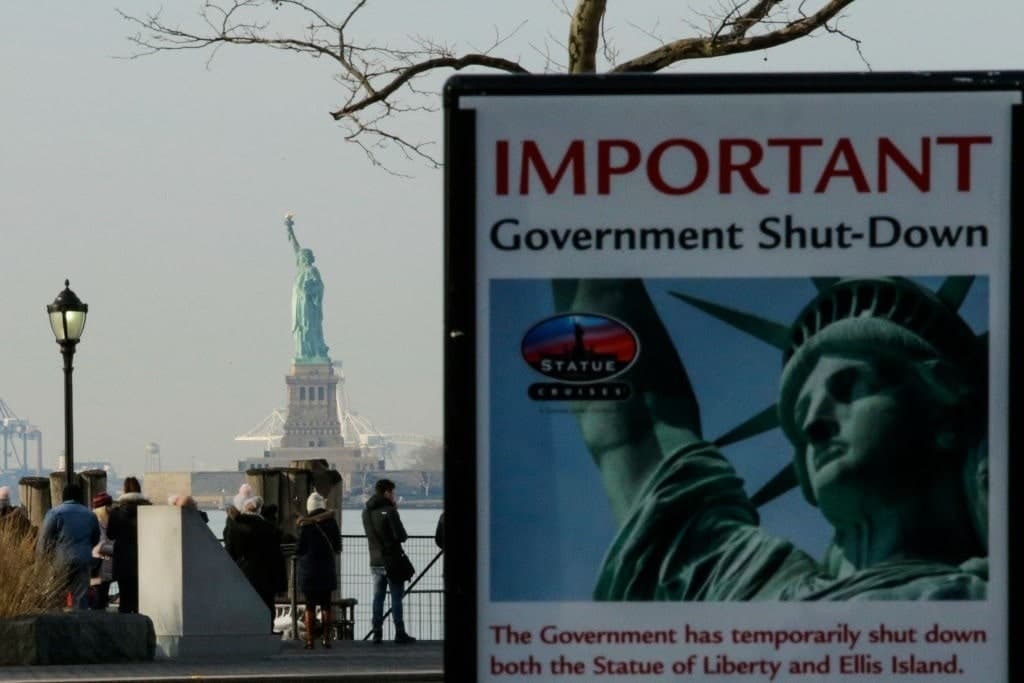

If you’re like most people, you have probably long since tired of hearing about a government shutdown. Every year without fail, Republicans and Democrats spar over continuing resolutions (CRs) to keep the federal government operating for a few weeks or months. Forget passing a full year’s budget. The last time that happened was 28 years ago, in the last century. So here we are again, one day away from yet another threatened closure of non-essential functions of the central state after a meeting between Trump and the majority and minority leaders from the House and Senate on Monday produced no agreement.
The difference this time is that most of the liability for this annual kabuki dance appears to rest not with the GOP, which usually gets outmaneuvered and blamed, but with Democrats, who can hardly afford yet another black eye.
Counting the Ways a Shutdown Could Damage the Democrats
There are multiple reasons to believe the party of the left would pay a steep price for its intransigence. For starters, the GOP-controlled House has already passed a CR that would keep the government operating until Nov. 21 at roughly the same current spending levels. Republicans made no sudden or provocative moves to add or subtract from the existing budget.

This means the burden of avoiding a closure falls on Democrats, especially since they have repeatedly attacked the GOP for issuing shutdown threats over the years. With 60 votes needed to pass the CR in the upper chamber, a refusal by at least 8 Democrats in the Senate to vote with the 52 Republicans who support the CR (GOP Sen. Rand Paul of Kentucky says he will vote against it) will signal that the Dems are serious about the specter of a government shutdown only if they can pin responsibility on Republicans. It would not be a good look for a party on the ropes.
Having lost control of both houses of Congress and the presidency, Democrats refuse to admit they are essentially powerless to do anything beyond persuading Republicans to adopt their position or backing down at the last minute. If Sen. Chuck Schumer (D-NY) and Rep. Hakeem Jeffries (D-NY) walk away from the negotiating table with a wary President Donald Trump, who has called their demands “unserious,” they will likely be blamed by voters at a time when their approval has dropped to its lowest point in the 21st century. And if they capitulate, they will be scorned, fairly or unfairly, by their angry and frustrated rank and file for failing to fight harder to get their way. They are damned if they do, damned if they don’t.
Specifically, Democrats are demanding a permanent extension of the COVID-era tax credits to the tune of $410 billion, plus several Medicaid-related items: cancellation of work requirements for able-bodied recipients; a repeal of limitations on healthcare provider taxes designed to control Medicaid spending; reversing a new law prohibiting recipients from claiming benefits in more than one state; and allowing illegal immigrants to participate in the program.
It is safe to say that none of those demands will be met by Trump and the GOP. As Speaker of the House Mike Johnson (R-LA) said late last week, "Senate Democrats, who used to warn that shutdowns would hurt seniors, veterans, and working families, are now threatening to force one unless Congress repeals the Working Families Tax Cut, restores taxpayer-funded healthcare for illegal aliens, and sends half a billion dollars to leftist news outlets, among other partisan spending demands."
In attempting to position his opponents as hypocrites, Johnson brought forth multiple examples of Democrats decrying government closures, including a statement in 2023 by Sen. Mark Kelly (D-AZ) in the midst of a shutdown showdown during the Biden administration: "A government shutdown would have serious impacts. Service members won't get their paychecks. Airports could have major delays. Nutrition assistance for children could be cut off. We can’t let any of that happen. Congress needs to work together to prevent a shutdown." Sen. Chris Murphy (D-CT) also added at that time, “I think this is a moment where reasonable people in the Senate … have to make sure that we are not making the perfect the enemy of the good."
The Trump Wild Card
Of the many ways a shutdown could damage Democrats, the biggest wild card is what actions President Trump might be willing to take before the government finally reopens. Following the adage that when the cat is away, the mice will play, the shuttering of government operations might well feed the president’s appetite for shrinking the size of the federal behemoth by laying off more government workers and paring down entire departments. And bureaucrats placed on leave would be unable to do anything about it.
At the same time, while many on the right who support a smaller government seem to care little about a temporary shutdown, it remains an undesirable outcome. Among other items, small business loans would not be processed, bureaucrats would be paid to not work, permits for significant energy projects would be delayed, and some medical trials would be put on hold.
Schumer was roasted on a spit by the left for going along with the last CR put forth by Republicans earlier this year. He appears intent on not doing so again, especially as he faces the prospect of a primary challenge in 2026 from far-left Rep. Alexandria Ocasio-Cortez. But while supporting a shutdown might be well-received by party insiders and activists demanding a fight, it would hardly be cheered by the majority of everyday Americans. Indeed, as we approach the deadline for avoiding a shutdown on Oct. 1, Democrats are stuck squarely between a rock and a hard place.