


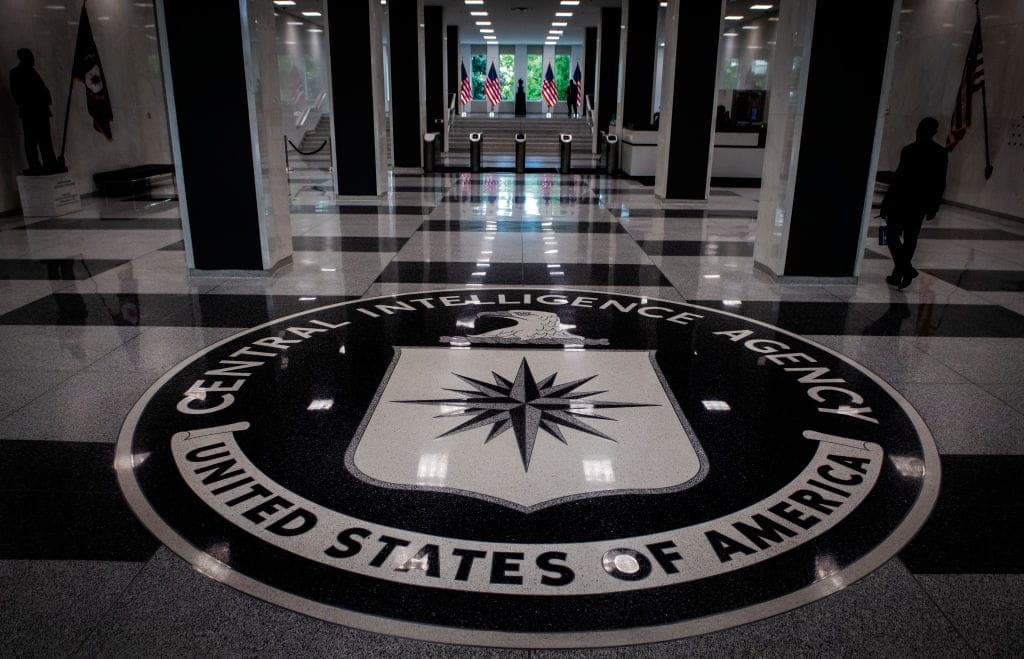

Artificial intelligence (AI) is apparently all the rage. But you may be thinking, “Well, duh, it has been for at least a decade.” Perhaps. However, when the Central Intelligence Agency (CIA) announces that AI is writing its reports, do allow for some pre-Pleistocene skepticism. However, that is exactly what CIA Deputy Director Michael Ellis told the audience at a recent Special Competitive Studies Project conference. In fact, Ellis went so far as to call AI a co-worker.
AI as an Intelligence Tool, Not a Human Substitute
Liberty Nation News’ Joe Schaeffer echoed suspicion regarding the emergence of AI use in journalism in his article “AP Goes AI and Establishment Media Red Flags Fly.” However, as we’ve learned, the news media is not the holy grail when it comes to truth, so to have a computer spit out a news article does not necessarily eliminate the element of disbelief in the reporting. In fact, it introduces a new critical question: Did a human write this story, or did “Hal 9000”? Which do I believe more? As Schaeffer pointed out, for the Associated Press, it was a matter of economics. Using AI to replace portions of its media operation could be cost-saving. Yet, it’s one thing to have the AP lean on AI for stories, but having the CIA use AI to write its reports is totally different.
According to Politico, “Ellis revealed that the agency recently used AI to create its first-ever autonomous intelligence report and projected that AI’s role in its analysis work will only grow.” Additionally, Ellis told the gathering, “It won’t do the thinking for our analysts, but it will help draft key judgments, edit for clarity, and compare drafts against tradecraft standards.” Apparently, there is no thinking involved with helping “draft key judgments.” As NextGov.com observed, “The AI tools would provide triage assistance and flag trends for human analysts to conduct further review.”
Then the NextGov.com story went from AI being a helpmate to something else and reported, “Within a decade, the CIA will treat AI tools as an ‘autonomous mission partner’ and officers will manage teams of AI agents in a hybrid model to increase the speed and scale of intelligence work, Ellis added.” Yikes, “autonomous mission partner”? It appears Ellis is saying that AI will identify important intelligence data, analyze it, draw conclusions, and independently identify and offer actionable responses, without any human interaction or input. When AI is given license to then execute on its findings, that’s where the line must be drawn.
From Liberty Nation News, Trivia, Facts, Check Us Out
Stay informed.
Today’s news, the Constitution and American history, written for young readers.
Visit GenerationLiberty.com
News, Trivia, Facts, Check Us Out
Stay informed.
Today’s news, the Constitution and American history, written for young readers.
Visit GenerationLiberty.com
NextGov.com explained, “The remarks provide a rare public glimpse into how one of the nation’s top spy agencies is integrating frontier AI systems into its day-to-day operations, and they signal that such platforms are expected to become a daily feature of officers’ workflows in the near future.” It’s just not clear that computers will ever be able to simulate the years of experience that intelligence field and case officers accumulate over a career. That’s what the users of the intelligence data have come to expect from the human intelligence community. The rush to rely on computers rather than human judgment and actions does not seem to be a good thing.
Political Bias Can Be Rooted Out
If the algorithm is applied to intelligence analysis data and results, criticisms that intelligence reports have a political bias favoring a particular point of view can be factored out. “President Donald Trump and other senior U.S. intelligence officials, including CIA Director John Ratcliffe, have vowed to root out an alleged left-wing tilt within the intelligence community,” Politico reported. In an AI-driven intelligence reporting environment, such biases would be removed. “But [Ellis’] speech hinted at how fights over the political valence of intelligence analysis may look different in an AI-centric future,” according to Politico.
Standing in the way of the adoption of more AI-generated products may be a fool’s errand; it has become an international pursuit. The intelligence agencies of the United States and Great Britain work together, and the CIA and the UK Secret Intelligence Service both have adopted AI capabilities. “We are now using AI, including generative AI, to enable and improve intelligence activities — from summarization to ideation to helping identify key information in a sea of data,” the Financial Times explained. The challenge will be to apply AI as a helpful tool, not as a substitute for human judgment. Machines cannot be held accountable; humans can.
~
The views expressed are those of the author and not of any other affiliate.



.jpg&w=1920&q=75)

.jpg&w=1920&q=75)