


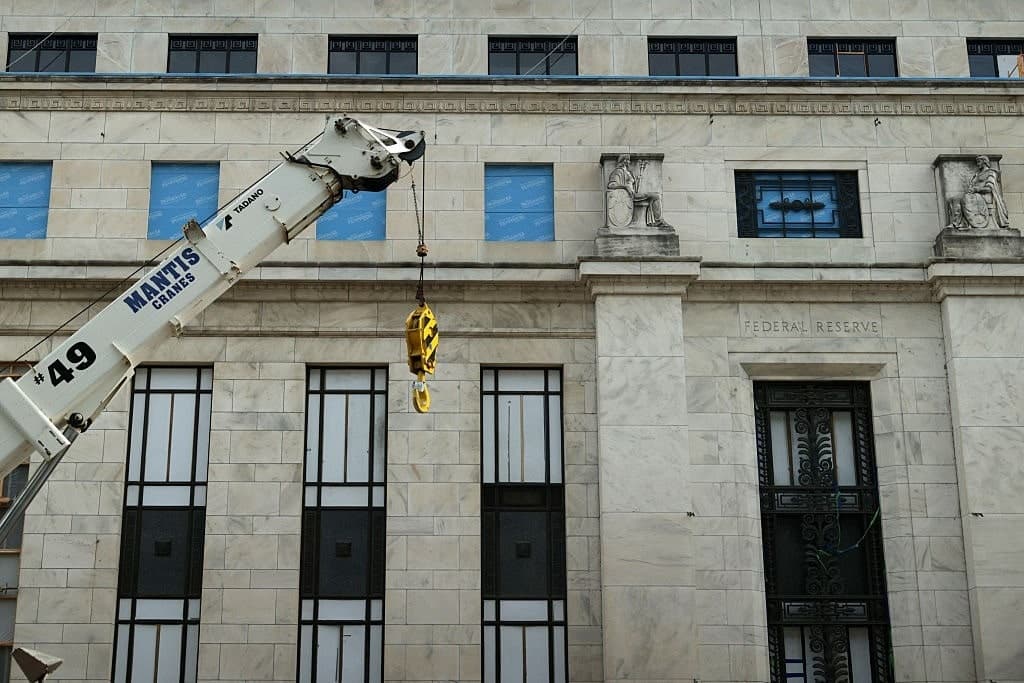

As the United States approaches its first year under President Donald Trump’s second presidency, significant changes have occurred in the country. Energy, finance, regulations, and taxes – the current administration has not been asleep at the wheel. One notable institution that is also witnessing policy changes, and is soon to undergo a major staffing overhaul, is the Federal Reserve System.
While the executive branch is, in theory, supposed to be at a football field-sized distance from the Fed, the institution appears to be embracing reforms ahead of a new sheriff in Eccles Town.
Feeling Stressed at the Federal Reserve
In addition to the central bank’s dual mandate – maintaining maximum employment and price stability – the Fed’s other responsibilities include bank regulation and supervision. A tool that supervisors wield is the annual stress test for the nation’s largest banks, including JPMorgan Chase and Bank of America. This has become a common practice for the institution since the global financial crisis, as officials ensure the big banks can weather the worst economic conditions.
Late last month, the Fed announced it would begin taking comments on proposals to reform the stress test system. This request for public feedback followed the Board of Governors' approval in December of an initiative aimed at improving the program, making it more effective, resilient, and transparent.
“Regulated firms should be subject to clearly articulated and transparent rules. Capital requirements should not be set in a way that is shielded from meaningful public scrutiny," Fed Vice Chair for Supervision Michelle Bowman said in a statement.
Inflation Targets
In 2020, the Fed introduced average inflation targeting to address inflation that consistently ran below the Federal Reserve's 2% target. The monetary authorities were concerned that they might not be able to stimulate the economy when inflation is low and policy is accommodative.
Five years later, as part of its review of the five-year monetary policy framework, the Fed scrapped it.
While it reaffirmed its 2% inflation target, policymakers abandoned average inflation targeting. This policy was designed to target an inflation rate of 2% over time. It backfired immensely, considering that Chair Jerome Powell has reached that arbitrary level only once in his tenure at the century-old entity. As Powell’s time as head of the Fed nears its end, the annual inflation rate stands at 3%.
Was this a reign of error?
Reading the Tea Leaves
Is the Federal Reserve omnipotent and omniscient? Many of its loudest cheerleaders think so.
But Fed Governor Christopher Waller, a heavyweight candidate to succeed Powell in May, does not believe the central bank can see beyond 12 months. As a result, it might be time to abandon or at least make changes to the quarterly Summary of Economic Projections (SEP) and the so-called dot plot (a visual representation of where officials think interest rates will be).
When asked at a Council on Foreign Relations event last month if it is time to get rid of the dots, Waller responded:
"I personally have doubts about whether we should have the SEP at all, but I've been told that, 'What are you trying to hide then? Why would you take them away? Why would you not be as transparent?'
"Now, you could change the dots. I personally believe you should get rid of the calendar dating, get rid of the long-run numbers, and just say, look, what's the next optimal policy over the next six, 12, 18 months? That's as good as we could do. So then it's a rolling number, and you get away from this crazy thing that's like, wow, there's three meetings left in the year. How many more rate cuts this year? Who cares? It doesn't matter."
His other admission that the Fed does not have any genius insights over anybody on Wall Street was a breath of fresh air, too!
Changes in Headcount
Over the next few weeks, Trump is expected to pick one of five candidates to lead the Federal Reserve over the next four years. The top candidates, according to predictive markets, are National Economic Council Director Kevin Hassett, former Fed Governor Kevin Warsh, BlackRock's Rick Rieder, and Waller.

But while who helms the ship is crucial, what happens behind the scenes is just as important.
Twelve reserve bank presidents’ terms are up for renewal at the end of February. Dozens of open positions at the Board of Governors and various regional central banks, from executive levels to senior economist, are currently available. The Eccles Building will also reduce its workforce by 10% over the next several years, from the current level of 24,000. Additionally, Bowman aims to reduce the Fed's supervision and regulation division by 30%.
When Stephen Miran’s position on the Board of Governors expires in January, Trump will have another opportunity to either renominate Miran to a 14-year term or choose somebody else.
Make the Fed Great Again?
It is unclear when the Federal Reserve last faced such scrutiny in Washington. Perhaps it was under former President Richard Nixon that the central bank was so harshly criticized. Whatever the case, the Trump 2.0 agenda has monetary policy and the Leviathan in its sights. The administration aims to overhaul the system, and reforms are being gradually introduced or implemented.


.jpg%20FISA&w=1920&q=75)
.jpg%20Starmer&w=1920&q=75)