

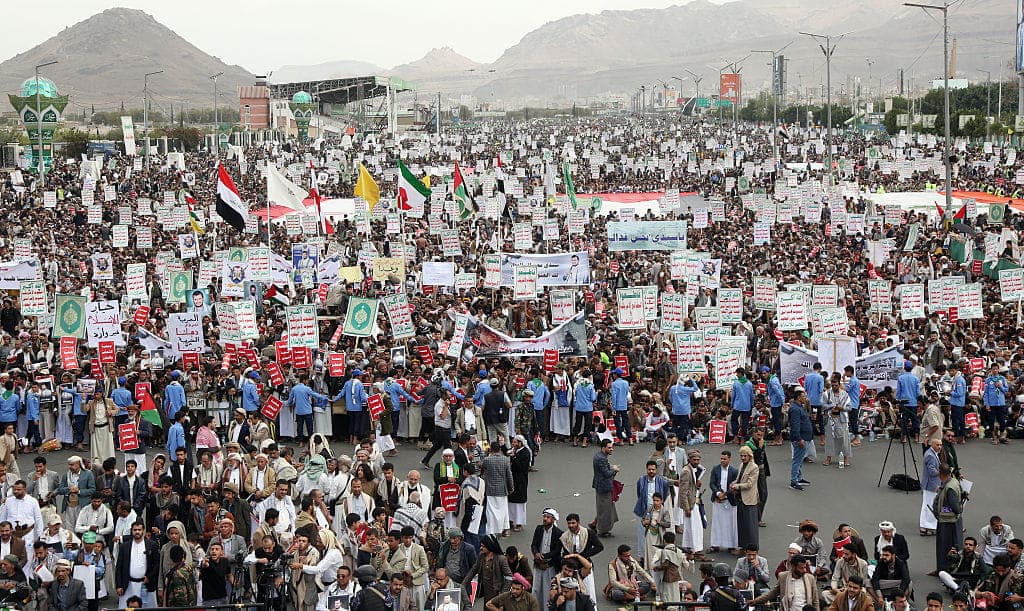

The Iran-sponsored Houthis, a Yemeni militant terrorist organization, control much of northern Yemen and remain a persistent problem in the Middle East. Houthis are engaged in regional upheaval using asymmetric attacks, including cruise missiles, drones, anti-ship missiles, and general maritime harassment. On July 20, the Houthis announced a naval blockade against Saudi oil exports from Yanbu, located halfway up the western Saudi Arabian coast along the Red Sea, through the Bab el-Mandeb Strait into the Gulf of Aden. Saudi officials have pledged to protect their shipping. Will the United States get dragged into this conflict? That is the question.
Houthis Causing Problems in Red Sea Again
It’s been more than a year since President Donald Trump executed an intense bombing campaign against the Houthis, which brought about a ceasefire that is still in place. Now the Iran-sponsored terrorists are threatening shipping in the Red Sea again. The Institute for the Study of War (ISW), in its “Iran Update Special Report” for July 20, 2026, observed: “The announcement of the blockade combined with the Houthis’ orders will almost certainly increase the cost of shipping through the Red Sea by discouraging ships from transiting through the Red Sea.” Increasing the cost of shipping through the Red Sea and disrupting the international marketplace raises the total global cost of the US-Iran conflict and puts significant pressure on the Trump administration to bring it to a rapid close.
According to the Associated Press:
“Saudi Arabia has been recently exporting some 4 million barrels of oil a day through its Red Sea port of Yanbu, blunting the impact of the Strait of Hormuz closure, which has still rattled economies around the world. Saudi Arabia could still get crude to market without using Bab el-Mandeb, by shipping up to 2.5 million barrels a day across the Red Sea to Egypt, whose SUMED pipeline can carry it to the Mediterranean. It could also ship 1 million barrels a day through the Suez Canal.”
However, traveling extended distances raises transshipment costs. What the increased use of pipelines does is reduce reliance on the Strait of Hormuz, thereby avoiding Iran’s threats altogether.
If the Houthis expand their threats to shipping beyond Saudi Arabian vessels, it would definitely create a point at which the United States and Houthis would clash. During a press availability at the White House, President Donald Trump made his position clear. If the Houthis made indiscriminate attacks on tankers and cargo ships, as they did during the conflict between Israel and Hamas, the United States would engage. “If something like that happens, we take care of it,” Trump told reporters.
Unlike Spring 2025, when the United States launched Operation Rough Rider, a campaign of airstrikes and naval actions against the Houthi rebels’ facilities, weapons, and leadership, the commander-in-chief does not have to move the necessary forces into position. In the conflict with Iran, an American armada of warships and ground-based US Air Force fighter aircraft, aerial tankers, command and control aircraft, as well as intelligence, surveillance, and reconnaissance capability, is present. It would not be a stretch for Trump to add the Houthis to the nightly target set.
Iran Benefits From the Disruption
It is unclear whether the Houthis’ actions result from an attempt to help Iran. The ISW explained in its July 21 release that it believes the Houthis’ motivation is for their own unique reasons. They announced the explanation for the blockade was in retaliation for Saudi airstrikes on Sanaa International Airport in Yemen. Nonetheless, as the ISW observed, “Iranian and Houthis interests align in this case, but the Houthis are not enforcing the blockade for Iran.” Regardless of motivation, the terrorist organization's threats to Saudi shipping disrupt global commerce, and that supports Iran’s strategy to make its conflict with the United States as geopolitically costly as possible.
Whether the United States likes it or not, its conflict with Iran may have to expand. As Trump told reporters, should the Houthis endanger US interests, “we take care of it.”
~
The views expressed are those of the author and not of any other affiliate.

.jpg%20Budget&w=1920&q=75)