



There’s a lot of talk and grumbling about AI data centers and how much they’re costing Americans. In fact, a new poll found that more people would rather live near a nuclear power plant than a data center. Technology is growing by leaps and bounds and in the artificial intelligence sector, the pressure to keep innovating and stay above competition is a driving force. But are we moving too fast, and do the benefits outweigh the dangers?
The Survey
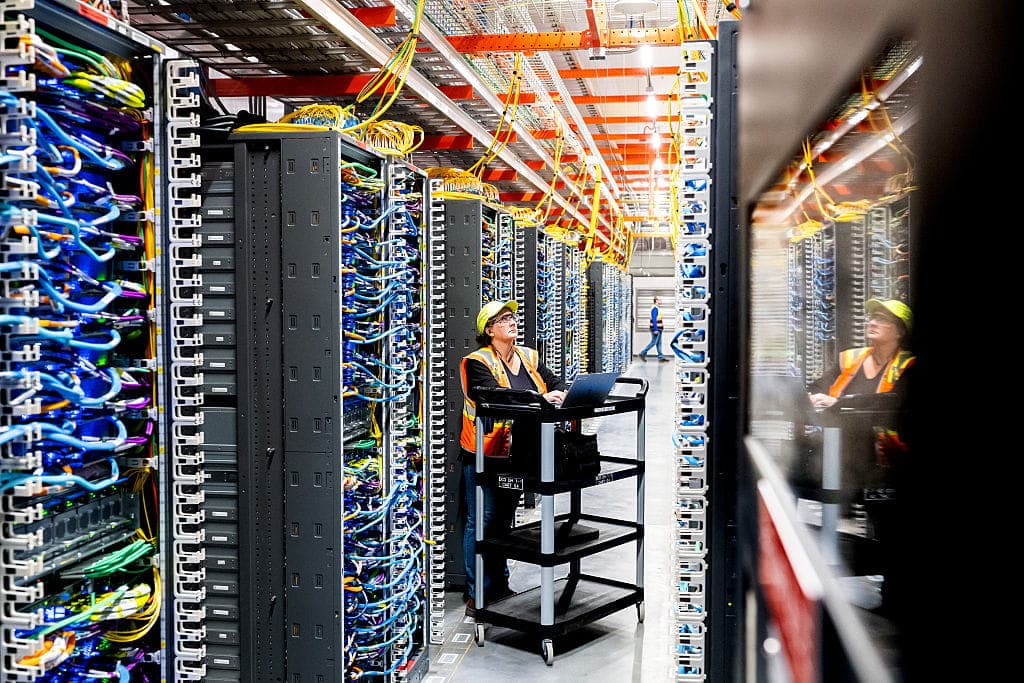
Data centers house equipment that helps power AI technology, which is used by businesses, universities, and more. These systems cover large land areas, require a lot of electricity to operate, and need a huge amount of water to cool the equipment.
A new Gallup survey found that “Seven in 10 Americans oppose constructing data centers for artificial intelligence in their local area, including nearly half, 48%, who are strongly opposed. Barely a quarter favor these projects, with 7% strongly in favor.”

In fact, people are so against these data centers that many would rather live near a nuclear power plant. “The data center question parallels the wording Gallup uses to ask about local nuclear power plant construction. In the same March survey, 53% of Americans say they oppose building a nuclear energy plant in their area, far less than the 71% opposed to data center construction. Since Gallup first asked the nuclear power plant question in 2001, the high point in opposition has been 63%.”
Why so much opposition? Folks fear what these areas will do to the environment, the impact on our resources, and, of course, the cost to our pocketbooks. John Steinbach of Virginia spoke with Consumer Reports, explaining how his electricity bill for January went from $100 the previous month to $281. “It’s just so far beyond any bill that I’ve ever had,” he said. John is concerned his bill will keep growing as more AI data centers are built. “They’re building them like it’s ‘Field of Dreams’ – build it and the electricity will come – but we don’t see how that’s going to happen.”
AI Data Centers
Proponents of the systems say they bring new economic opportunities, jobs, and needed technology. But others argue the risk is too great, that these data centers are eating up valuable resources. Data centers are voracious when it comes to water consumption. This need threatens freshwater supplies. As Environmental and Energy Study Institute (EESI) explained: “Only 3% of Earth’s water is freshwater, and only 0.5% of all water is accessible and safe for human consumption. Freshwater is critical for survival. On average, a human being can live without water for only three days.” Furthermore, “Increasing drought and water shortages are reducing water availability. Meanwhile, data center developers are increasingly tapping into surface and underground aquifers to cool their facilities.”
According to EESI, a medium-sized center can use up to around 110 million gallons of water per year, which is equivalent to about what 1,000 households would use in the same time frame. Larger ones can consume up to five million gallons per day, which is about 1.8 billion a year, the equivalent to a city of 10,000 to 50,000 people. By 2021, all the data centers together in the US consumed an estimated 449 million gallons of water per day, or 163.7 billion gallons a year.
To put that into a little more perspective, scientists at the University of California, Riverside, suggest that a 100-word AI prompt, such as what someone might type into systems such as ChatGPT, uses about one bottle of water. Millions of users worldwide enter such prompts every minute.
Data centers haven’t just recently sprouted up; they’ve been in use for decades. However, in late 2022, things changed with the introduction of ChatGPT and the need for more resources – primarily water, land, and electricity. Where they are located has an impact on usage as well. In hotter climates, EESI explained, such as the southwest, data centers need to use more water to cool the equipment and buildings. “With the increasing number of centers supporting AI requests, chip density is also growing, which leads to higher room temperatures, necessitating the use of more water chillers at the server level to maintain cool temperatures,” EESI explained.
What’s the Government Doing?
Data centers suck up natural resources, straining an already aged and limited power grid, which has many worried about the supply availability to Americans. Data centers could consume as much as 12% of the power grid by 2028, E&E News reported. “As individual data centers balloon in size and can consume as much power as cities, their impact on the grid extends beyond their immediate construction and can necessitate upgrades to equipment or new generation.”
In March, President Donald Trump posted on social media that his administration is working with tech companies on policies that would help the centers to grow but without raising costs for the people. “I never want Americans to pay higher Electricity bills because of Data Centers,” he posted.

Amazon, Google, Meta, Microsoft, OpenAI, Oracle, and xAI signed the Ratepayer Protection Pledge, according to a White House statement. With this, the businesses agree to “build, bring, or buy new generation resources and cover the cost of all power delivery infrastructure upgrades required for their data centers, ensuring such expenses are not passed to American households.”
As artificial intelligence continues to expand, Americans find themselves caught between excitement over new technology and concern over what it may cost them in the long run. AI data centers might help power innovation, jobs, and economic growth, but they also place enormous demands on local infrastructure. People aren’t just worried about futuristic robots taking over jobs anymore; they’re concerned about rising utility bills, strained resources, and whether their communities will be forced to shoulder the burden of technological advancement. The debate over AI data centers is quickly becoming about more than technology. It’s becoming a question of who benefits, who pays the price, and whether America can balance innovation with protecting the people and resources that make everyday life possible.

.jpg&w=1920&q=75)