
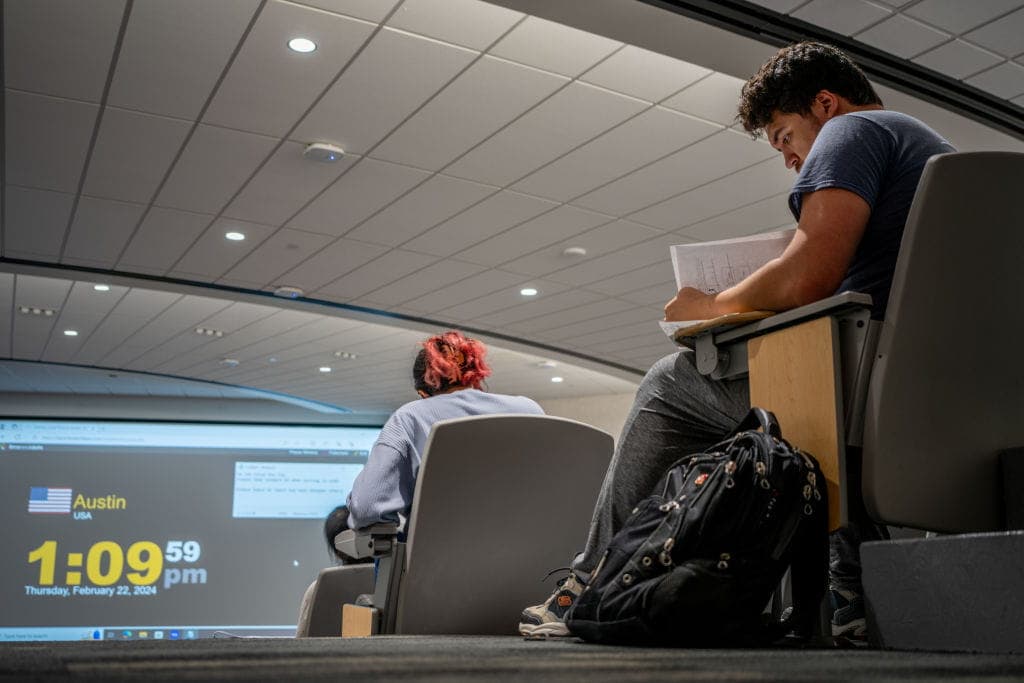

The surging popularity of a college entrance exam is reigniting debates over the purpose of education. A handful of universities in Indiana and North Carolina will now consider the Classic Learning Test (CLT) as an alternative to ACT and SAT scores. Other states and colleges are also weighing the option. Even the Pentagon is now accepting the CLT for US military service academies. Nearly 183,000 students took the test last year, up from 291 a decade ago. Texas is taking it a step further and pushing changes to its English and social studies instruction, moving the courses toward a style closer to classical education. The renewed interest in this model reveals a fundamental divide.
Two Competing Visions of Education
Classical education is rooted in ancient Greek and Roman tradition, using the “Trivium” of grammar, logic, rhetoric. The system aims to cultivate reason through history, literature, and philosophy, using books from Aristotle, Dante, Frederick Douglass, C.S. Lewis, Adam Smith, and even Karl Marx, to name a few. It “starts with a vision of the human person that transcends time, place, and socio-political affairs,” explains the University of Dallas, and “focuses on cultivating virtue, wisdom and historical consciousness, not merely on job training, home economics, or the perceived socio-political concerns of the present moment.”
Students have to follow difficult arguments and grapple with enduring ideas, said Jeremy Tate, the founder of the company behind the exam, commenting on an article from The Washington Post discussing the rise of the Classic Learning Test. “By contrast,” he said, “the new redesigned SAT reflects a different philosophy: shorter passages, fragmented reading, and an approach that often accommodates declining attention.”
Tate pointed to a Grove City College study that discovered that the CLT is the “strongest predictor of first-year GPA among major admissions tests.” That seems like a win for CLT, but “the real question,” said Tate, “is not just which test better predicts GPA. The real question is what kind of student are we trying to form?”
The system widely used in public schools today tends to shape kids primarily for jobs and careers, focusing more on the present than history and the past, according to the University of Dallas. This model, often referred to as progressive education, emphasizes self-expression, social learning, and adapting to modern life. Literature and poetry take a backseat in favor of “useful” reading. Civics hinges on the mechanics and procedures of democratic life, with little attention to its history or to political philosophy. Fine arts and foreign language, such as Greek and Latin, are ostensibly viewed as inessential endeavors.
Instead of challenging students, many schools are dismantling ability-based grouping and integrating certain courses, known as “detracking.” San Francisco and Cambridge used this reform process, terminating math courses to reduce demographic disparities in academic performance – all in the name of equity. Rather than lifting students to their highest potential, some schools are forcing many children to learn on the same level as the lowest achievers.
The Choice Ahead
Seventy-five percent of US parents with school-aged children said they considered new schools in 2025, according to the National School Choice Awareness Foundation. A majority of the alternatives to public education use the classical education model or a similar traditional style. Even people who homeschool their kids often lean toward close readings of original texts, sustained dialogue, and intellectual skills.
From Liberty Nation News, Trivia, Facts, Check Us Out
Stay informed.
Today’s news, the Constitution and American history, written for young readers.
Visit GenerationLiberty.com
News, Trivia, Facts, Check Us Out
Stay informed.
Today’s news, the Constitution and American history, written for young readers.
Visit GenerationLiberty.com
Classical education now “encompasses more than 1,500 public, private, and charter schools serving nearly 700,000 students,” explains the Thomas B. Fordham Institute. “By 2035, projections suggest that number could reach 2,600, enrolling well over a million children.”
Will the CLT spark a bigger movement and encourage others to champion critical thinking and character over rote skills? It all depends on what kind of student – and citizen – Americans want. Does the country need more somnambulant workers and AI prompt specialists or more cultivated thinkers with a well-ordered grasp of human nature? The answer could define our shared future.

.jpg&w=1920&q=75)
.jpg&w=1920&q=75)
.jpg&w=1920&q=75)