
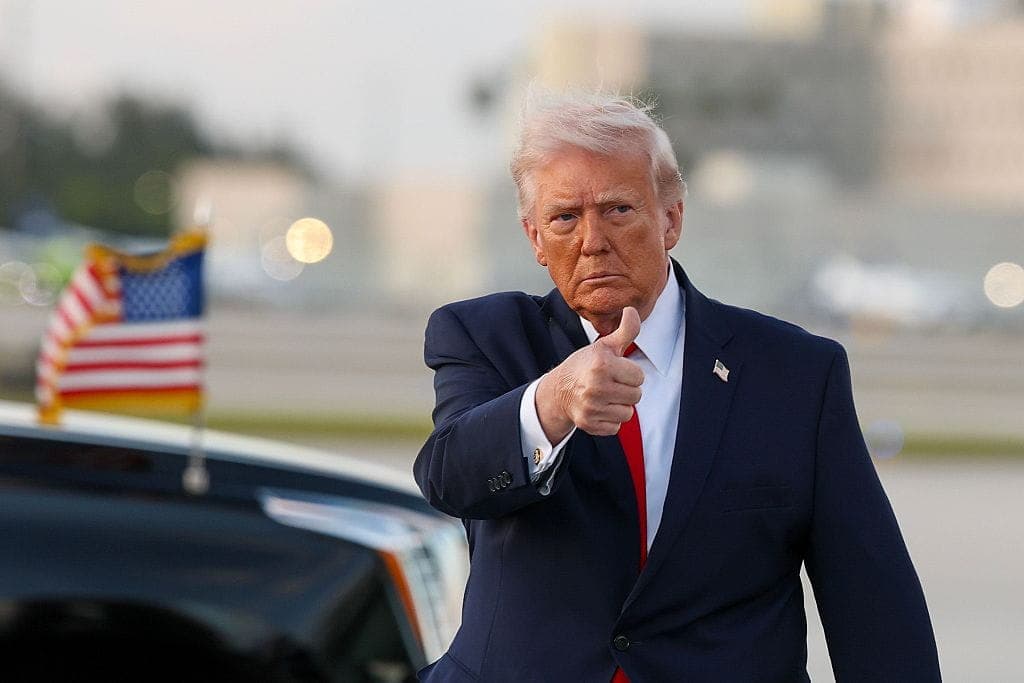

Almost everyone on both sides of the political aisle would agree that the impact of Donald Trump on American politics has, for better or worse, been seismic. Those who love or hate him will long remember this decade in which the 45th-turned-47th president entirely changed the nation’s political landscape, seeking and accomplishing objectives previously written off as unrealistic or outside the guardrails of conventional political thought. So, with 30 months still remaining in his historic presidency, the question turns to which of Trump’s radical reforms will stand the test of time and remain a permanent part of our political fabric in the years and decades ahead.
Let’s place the president’s accomplishments into three categories: those likely or certain to last, those that might linger, and those that stand little chance of remaining in place beyond this president’s second term. Many policies and decisions by 47 can be categorized as the genie leaving the bottle or the toothpaste being squeezed out of the tube.
Trump’s All-But-Permanent Reforms
The massive One Big Beautiful Bill (OBBB) Act contains a host of reforms, including no taxes on tips, overtime, and social security. Would a future president or Congress move to start taxing them again? That is highly unlikely anytime soon. There are also some decisions Trump has made that are of global significance and cannot be reversed. Venezuela has finally been liberated, Iran has been deprived of its ability to threaten world peace, and Cuba is falling apart, as even the left realizes communism on the island paradise is dying a slow, painful death. Trump has closed the southern border and reversed the frightening spectacle of millions of illegal aliens entering the country unchecked during the Biden years. Considering that this was a principal reason for Trump’s victory in 2024, any Democrat who might be elected in 2028 would open the border at their own great peril.
The administration outed the mass boondoggle that is USAID, which has been all but shuttered following revelations of indefensible expenditures for woke projects across the globe. No future chief executive is going to try and defend the textbook waste, fraud, and abuse that came to define the agency. The president has reduced the federal workforce by 10%, removing 238,000 civilian employees to date, and taxpayers will be loath to support expanding it. Trump has put diversity, equity, and inclusion (DEI) on extinction in the federal government, and much of the private sector has followed suit. Likewise, transgender and climate change hysteria, and the grafting of biological males into women’s sports have all been discarded in the proverbial ash heap of history.
The president has made a historic commitment to modernizing and expanding the US military, and the results are self-evident in multiple audacious missions to Iran and Venezuela that succeeded against all odds and have fundamentally changed the world. He has called for a 40%-50% increase in the defense budget and forced NATO nations to commit 5% of their gross domestic product (GDP) to defense, shifting much more of the burden of defending Europe onto the nations that have long been free riding on the US. While a new president might not publicly hold European nations to their promise, a new standard has clearly been set.
When you add up all these monumental accomplishments, one could make a credible argument that the principal reason Democrats are so spooked by Trump is that they realize so many of his reforms that they bitterly oppose will outlast his presidency. There are also a number of policies that don’t qualify as world-changing but are nevertheless significant. A recent example is the executive order by the president seeking to fix the growing problems in college sports.
Trump Policies That Might Last – Or Not
Then there are Trump policies that may or may not be attractive to future presidents. His push for energy independence and dominance will ultimately benefit Americans once the conflict in Iran is settled. But a future president from the Democratic Party might recoil at the philosophy of “drill baby drill,” at least publicly, to assuage the environmental fears of his liberal constituency. MAHA (Make America Healthy Again) has broken much new ground and finally made people aware of the dangers of processed foods and additives that have driven the rate of chronic disease across the land to an unsustainable 60%, compared to less than 10% a half-century ago. As with Trump’s energy policies, a Democratic president would likely embrace the most popular parts of Robert F. Kennedy Jr.’s MAHA agenda without paying it lip service, while bringing back establishment figures to run the Department of Health and Human Services (HHS).
President Trump has pushed to revitalize the country’s nuclear power industry as a key component of energy independence and necessary to handle the outsized energy demands of artificial intelligence (AI). Whether a future president would continue the process is in the land of the great unknown, but with their predictions of environmental catastrophe having been effectively debunked over the years, the left and the country as a whole have become more open to nuclear energy. The thorniest issue for a future Democrat in the White House might be Trump’s crusade for election reform at the federal level. A supermajority of Americans support the need for voter ID, so how would a Democratic Party chief executive thread the needle when his party has constantly called voter ID racist on its face? And how about the federal death penalty reinstated by Trump? Would a Democrat concur or dissent?
DOA With the Next Democrat in the White House
Finally, we come to Trump’s policies that seem certain to fall by the wayside once he leaves office. Following what many believe were reckless decisions by former Homeland Security chief Kristi Noem, a short leash will likely be placed on Immigration and Customs Enforcement (ICE), which will likely never be seen in quite the same favorable light as it once was. A Democrat in the White House would probably significantly alter Trump’s signature tariff regime, as well as reverse this president’s decision to leave the World Health Organization (WHO).
Most of Trump’s policies have been advanced through a tidal wave of executive orders, many on so-called 80-20 issues that have drawn the oppositional Democrats into defending the 20% position simply because Trump issued the order. Even though such executive proclamations can always be reversed or discarded by future administrations, this president is clearly making moves aimed at permanent change. And since Trump can command his “pen and phone” for the rest of his term, even if Republicans lose control of the House and Senate, you can expect his frenetic pace of reform dictated from the Oval Office to carry on.
This is what happens when the nation is willing to elect, and re-elect, a totally out-of-the-box president, especially on the heels of the most conventional establishment politician in our lifetime, Joe Biden. Donald Trump has expanded the “Overton Window” of acceptable political beliefs more than any president since Franklin D. Roosevelt and his New Deal in the 1930’s. Policies previously thought unattainable or unrealistic are now part of the national fabric. The 45th and 47th president has altered the political landscape to a stunning degree, setting new standards in multiple areas that are unlikely to be changed by future presidents for as far as the eye can see.
Domestic policy aside, it’s hard to argue against one fundamental premise. Considering how the corrupt rulers of Venezuela and Iran have been brought to their knees – and how the Trump administration has brokered peace deals or ceasefires on at least eight different fronts – the president’s successor, no matter the party, will be handed a far safer world than the one he inherited. Ironically, the 47th president may want to adopt the slogan employed by Kamala Harris, the woman he defeated in 2024: We’re not going back.

.jpg&w=1920&q=75)
.jpg&w=1920&q=75)
.jpg&w=1920&q=75)