


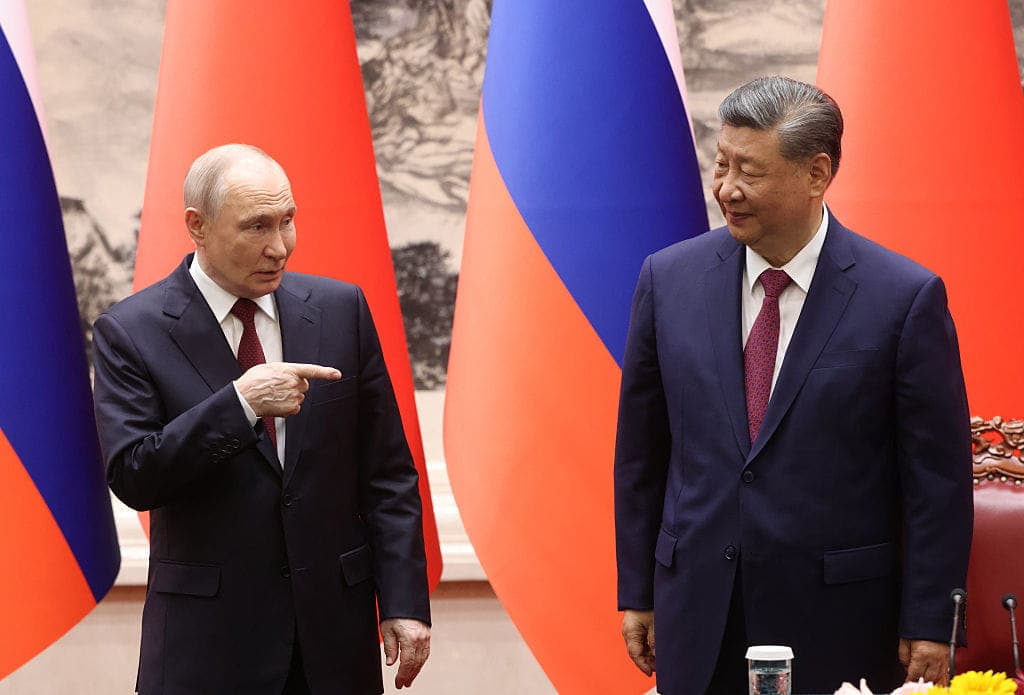

Just days after President Donald Trump’s visit to China, Russian President Vladimir Putin spent May 19 and 20 in meetings with Chinese Communist Party (CCP) leader Xi Jinping. Putin's trip to Beijing is the most recent of many such diplomatic junkets the Russian leader has made to its neighbor to the south. The Global Times, a CCP-run news outlet, pointed out that “[t]he visit marks Putin's 25th trip to China," which is "more than any other incumbent leader of a major country.”
One takeaway from the frequency of Putin’s trips to China is that they underscore the close relationship between Russia and the Red Dragon. But there is a flip side to that perspective: The relationship is fragile and requires frequent outreach from Moscow. This recent trip, coming so close on the heels of Trump’s visit, lends credence to the notion that Putin wanted to ensure no fissure was developing in what has been touted as a “no limits” partnership. From China’s perspective, there appears to be an attempt to balance the Sino-Russian bond with the Trump friendship.
China Leaves an Impression
During a May 20 press conference, the Chinese Ministry of Foreign Affairs spokesperson noted that Putin's visit marked the “30th anniversary of the signing of the China-Russia Treaty of Good-Neighborliness and Friendly Cooperation.” It was clear that China wanted to leave the impression that the strategic relationship was as strong as ever. What is equally apparent is that the multipolar world Russia and China like to push is, in reality, viewed by Moscow and Beijing as bipolar, with the two major powers leading the way. The Kremlin and CCP are collaborating to “uphold international fairness and justice and promote the building of a community with a shared future for humanity.” The Foreign Ministry spokesperson closed his comments with:
“The relationship has entered a new stage with greater achievements and faster growth. As permanent members of the UN Security Council and major countries in the world, China and Russia will, in light of the strategic and long-term goals, promote higher-standard comprehensive strategic coordination to boost respective development and revitalization and contribute to a more just and equitable global governance system.”
No one should be confused. What is a “just and equitable global governance" system? It is a world order in which China and Russia are the leaders, and the needs of the two supersede those of other nations, particularly the United States and other Western nations. To that end, “Putin and Xi oversaw the signing of more than 40 cooperation agreements in areas such as trade, technology, and media exchanges,” according to ABC News. Expanding trade between the two countries, particularly in the oil and gas sectors, was among the key topics on which the two sides agreed. Furthermore, there was no veil on whom Putin and Xi identified as the problem.
From Liberty Nation News, Trivia, Facts, Check Us Out
Stay informed.
Today’s news, the Constitution and American history, written for young readers.
Visit GenerationLiberty.com
News, Trivia, Facts, Check Us Out
Stay informed.
Today’s news, the Constitution and American history, written for young readers.
Visit GenerationLiberty.com
“Throughout the visit, Mr. Xi and Mr. Putin cast themselves as a stabilizing force in a world thrown into tumult by Washington,” The New York Times observed. “In joint documents issued during the visit, China and Russia set out a vision of a post-U.S.-led world order that promises nations more equality and mutual respect, even as those stated ideals contrast sharply with Moscow’s invasion of Ukraine and Beijing’s muscle-flexing across Asia,” The Times continued.
China remains a strategic economic and military threat to the United States. The Putin visit with Xi revealed the wolf beneath the sheep’s clothing that Xi wore during his encounter with Trump.
~
The views expressed are those of the author and not of any other affiliate.


.jpg&w=1920&q=75)
.jpg&w=1920&q=75)