

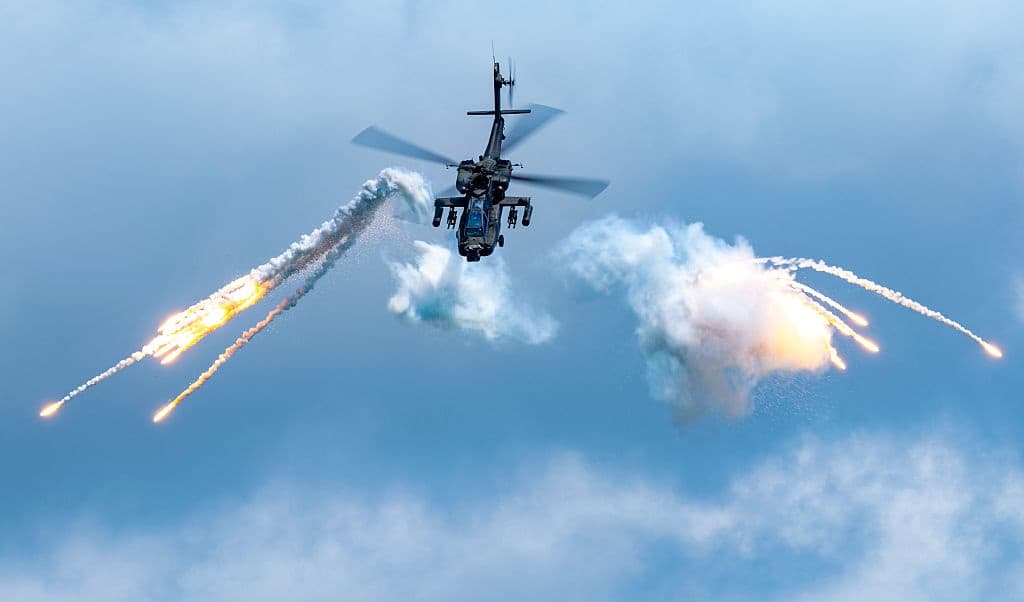

Reports from US Central Command say that, while on patrol off the coast of Oman near the Strait of Hormuz, an Apache AH-64 attack helicopter crashed. The two crew members were rescued. Early reporting by The New York Times indicated, “It was not immediately clear whether the Apache was shot down by Iranian fire, experienced mechanical failure, or encountered some other problem.” Subsequent reporting from CNN claimed the US helicopter was hit with a drone from Iran. Regardless, President Donald Trump has ordered a retaliatory strike.
Tensions Between the US and Iran Grow
This incident more than likely will set back negotiations between the United States and Iran. In an X post, US Central Command explained that the Apache crew was picked up “within approximately two hours and are in stable condition.” What made the rescue unique was that, for the first time, as CNN explained, “The successful rescue of the two uninjured crew members — accomplished in part by a US Navy unmanned surface vessel (USV) from Task Force 59 in a historic first for aircrew water recovery — demonstrates the innovation and readiness of our forces under this administration.”
At this writing, a definitive cause for the downing of the aircraft has not been verified. It was reported by CNN that, “Two US officials said the helicopter was brought down by an Iranian drone. A separate source familiar with the incident said it was perhaps an Iranian Shahed drone that struck the US helicopter.” There is speculation that in the highly congested airspace over the Strait of Hormuz, the drone simply ran into the aircraft, since that type of drone is not normally considered an anti-aircraft weapon. However, whether on purpose or by accident, the Iranian drone was not up to any good; it was launched to attack something.
Following the news of the loss of the combat aircraft, President Donald Trump was quick to reveal his intentions in a Truth Social post:
“I have just been informed by our Great Military that last night [June 8] the Iranians shot down one of our highly sophisticated Apache Helicopters while patrolling over the Strait of Hormuz. There were two pilots involved, both are safe and uninjured. Nevertheless, the United States must, of necessity, respond to this attack. Thank you for your attention to this matter! President DONALD J. TRUMP”
So, with the information the president has, he has ordered a “self-defense” (read retaliatory) strike on Iran. Though, so far, most likely the air attacks are against military targets like Iranian air defense and drone facilities. In an X post, US Central Command explained, “U.S. Central Command (CENTCOM) forces began launching self-defense strikes against Iran at 5 p.m. ET today at the Commander in Chief’s direction, in response to yesterday’s downing of a U.S. Army Apache helicopter. The mission is a proportional response to unjustified Iranian aggression.” How aggressive the United States is going to be and to what extent it will continue the air operations are unknown.
However, in the face of stalled peace negotiations, this kind of action is what many pundits and military experts have been recommending. Back in April, retired Gen. Jack Keane, former US Army Vice Chief of Staff, told Fox News, “I am skeptical about where we’re heading with the Iranians because I flat don’t trust them, and I don't like taking the pressure off them by going to a ceasefire, which is what they want in any event to force the United States to stop the war.” Keane has been a steady advocate for holding Iran’s feet to the fire with credible military pressure, eliminating the opportunity for Tehran to reconstitute its missile and drone capability.
Strength of Will
What should not happen in response to the downing of the Apache is a weak tit-for-tat retaliation. In keeping with the Trump administration’s mantra “Peace Through Strength,” the United States should retaliate with significant force to get the Tehran leadership’s attention. During the current so-called ceasefire, Iran has continued to launch ballistic missiles at Israel, cruise missiles and drones at US Gulf region allies, and attack shipping in the Hormuz Strait. That has to stop. The Strait of Hormuz must be open to the free transit of commercial shipping.
Furthermore, the US demands regarding turning over nuclear material must be met. If that means reducing every Iranian military headquarters building, weapons production facility, and warehouse, key infrastructure, or command and control node to rubble, so be it. Iran thinks it has the upper hand. It does not, and it needs to be shown precisely just how weak a poker hand it holds.
Trump’s message sends the right signal. Now, that needs to be followed by an unmistakable show of force. Anything less invites an Iranian miscalculation of US weakness of will.
The views expressed are those of the author and not of any other affiliate.

.jpg&w=1920&q=75)